Company competitions have potential that classic teambuilding often fails to use. They last longer, take less energy and money, and engage even colleagues who would rather avoid big offsite events. The main question when planning them is usually completely banal — what to actually organise?
This list offers 10 ideas that really work in companies. They are ordered from the simplest organisationally to the ones that require more preparation but still do without an external agency.
1. A sports prediction league for a big tournament
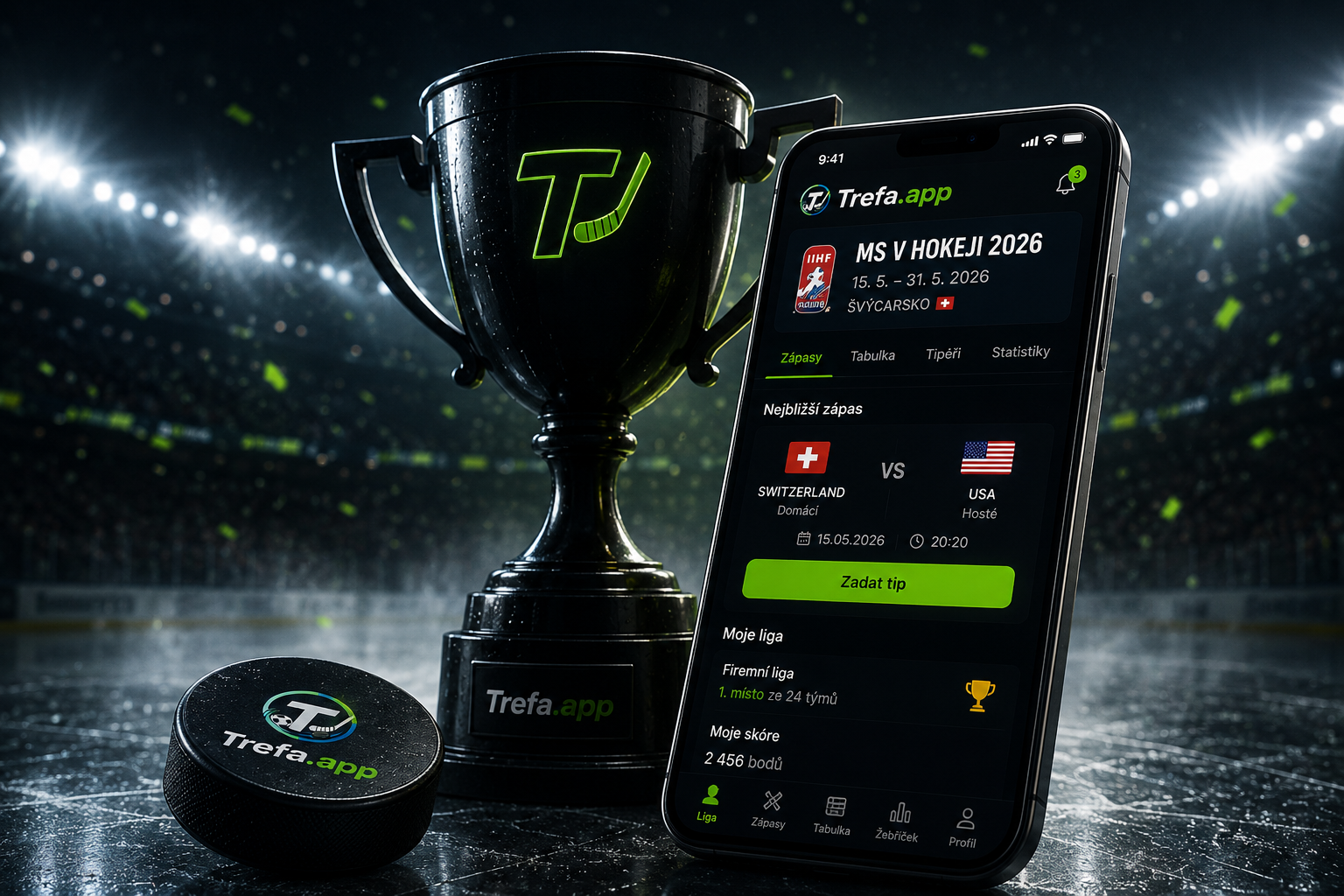
The simplest and at the same time one of the most effective ideas. All it takes is the Ice Hockey World Championship, the UEFA EURO, the Olympics or the NHL play-offs coming up, and you have a natural frame for a company-wide competition.
Colleagues predict match outcomes, the leaderboard shifts day by day, and every new match day brings the topic back into team chats. It runs for several weeks, so the atmosphere lives by itself. If you want the prediction league to run without your intervention, use a dedicated tool that syncs results automatically — your admin work is then just sending out the link.
Effort: low. Budget: zero to symbolic (prize for the winner). Duration: the length of the tournament, typically 2–4 weeks.
2. A step challenge
Most people have a step counter built into their phone today (Apple Health, Google Fit, Fitbit). Just agree on the rules — for example, "whoever walks the most steps in a month" or "the team that collectively walks the most kilometres in four weeks" — and the activity runs by itself.
It works great for hybrid teams too. A colleague on home office who goes running vs. a colleague from production who racks up steps during her shift. Bonus: people start moving more, so HR has something to report too.
Effort: low. Budget: small (prize for the winner + possibly a tracking app subscription). Duration: a month or a quarter.
3. A photo contest with a company theme
You announce a theme — for example "my workplace nook", "the most creative dress code on Friday", "pet in home office" — and colleagues send photos. After a week there is voting, then the winners are announced.
The theme decides the success. If you pick something everyone can easily access, even those who do not normally respond to challenges will join in. Themes that demonstrably work: pets, morning coffee, holiday views.
Effort: low. Budget: zero. Duration: 1–2 weeks.
4. A knowledge quiz
A classic Kahoot quiz after work or during a regular company all-hands. Questions can be mixed — general knowledge, pop culture, company knowledge (who joined in what year, how many customers we have in Poland). The second category of questions is surprisingly successful — colleagues are entertained, but at the same time pick up company facts informally.
It suits a recurring company-wide event, not a one-off. If you run a quiz monthly or quarterly, it becomes a tradition.
Effort: medium (preparing questions takes 1–2 hours). Budget: free (Kahoot has a free tier). Duration: 20–30 minutes per episode.
5. A bake-off or cooking contest
Who bakes the best cake? Who brings the most unusual open sandwich? Who makes the best guacamole? A classic that works across all age groups and opens conversations between colleagues who otherwise might not meet.
It suits in-person offices where colleagues sit physically together. For hybrid teams it needs to be adapted — for example "a photo of your creation" instead of a live tasting.
Effort: medium (organising the day + buying ingredients). Budget: small. Duration: one-off event, 1–2 weeks of preparation in advance.
6. Guess who from childhood photos
Each employee sends one childhood photo (age 3–8). You collect them anonymously, build a gallery and colleagues guess who is who. It works great because people like nostalgia and at the same time learn surprising details about each other.
A small caveat: watch the company size. For 10–30 people it is ideal. For 100+ it becomes unsolvable and the activity loses its charm.
Effort: low. Budget: zero. Duration: 1 week for collecting photos + 1 week for guessing.
7. A fantasy league or NHL/NFL draft
If you have sports fans on the team, a fantasy league is a format that runs all season (typically 6–7 months). Participants draft players at the start, set their lineup every week and points are counted based on real-world stats.
This is the hardcore variant of a sports competition — it requires much more engagement from participants than a prediction league, and therefore suits only a motivated group of fans. Not really for the whole company.
Effort: high (requires a fantasy platform like ESPN Fantasy or Yahoo). Budget: free. Duration: the whole season.
8. A hidden talents open day
You announce a day when colleagues can show off their hidden skill. Someone can juggle. Someone plays the guitar. Someone lives in the cave of their hobby — a watch collector, a model train builder, a unicyclist. Collect entries, set aside an hour during a team meeting and let people tell their story.
It works wonderfully for building relationships — people show themselves from a side other than "the colleague from marketing". It is not a classic competition with a winner, but it works as an ice-breaker with a long-term effect.
Effort: medium (collecting entries + organising the presentations). Budget: zero. Duration: one afternoon.
9. An inter-department sports tournament
If you have a ping-pong table in the office, darts, foosball or even a PlayStation, you can hold a tournament once a month. Marketing vs. development, sales vs. ops. A bracket, simple rules, a small prize for the winner.
This works great for companies with 30–150 people. With smaller teams you do not have enough competitors, with larger ones the organisation gets complicated. If you do not have a physical office, you can use an online sports tournament (for example a Chess.com tournament for the whole company).
Effort: medium (running the bracket). Budget: symbolic. Duration: 1–2 weeks.
10. A second prediction league for a different tournament
If the team already ran a prediction league for the Ice Hockey World Championship and it worked, it is very likely that the next big tournament will engage even more people. People will remember the previous round, the inside jokes will still be around and they will want a rematch.
Sports tournaments complement each other well — Ice Hockey World Championship in May, the UEFA EURO in June/July, the NHL play-offs in spring, the Olympics every two years. If you organise two prediction leagues a year, you create a small tradition in your team that colleagues look forward to.
The same format, the same tool, just a new prediction league for the next tournament. The second round is always easier — you know what worked and what did not.
Effort: low (you already know the process). Budget: symbolic. Duration: the length of the tournament.
What to choose
If you are starting from scratch, I recommend a sports prediction league for the next big tournament (idea #1). It has the best ratio of result to work, engages a wide spectrum of people across departments and costs almost nothing.
If you want a regular low-frequency activity that runs all year, combine a step challenge (#2) with an occasional quiz (#4). This pair does not require seasonal timing and works any time.
And if you want a one-off event that creates a nice memory, try the bake-off (#5) or Guess who from childhood photos (#6) — both demonstrably work regardless of company size.